Bicorne Journal participates in the Amazon Associates Program. As an Amazon Associate, I earn from qualifying purchases — at no extra cost to you.
The morning of June 18, 1815 was wet and cold, and Napoleon Bonaparte was eating a late breakfast in a farmhouse called Le Caillou. He was forty-five years old, in poor health, and within sight of the British and Allied army he intended to destroy by sunset at the Battle of Waterloo. Across his table that morning sat Marshal Soult — a veteran of the Peninsular War who knew the British army from twenty different battlefields — and Soult was nervous. He warned the Emperor not to underestimate Wellington. Napoleon dismissed him.
“Because you have been beaten by Wellington,” he reportedly said, “you think him a great general. I tell you he is a bad general, the English are bad troops, and this affair is nothing more serious than eating one’s breakfast.”
The quote shows up in several officer memoirs of varying reliability and Soult himself never confirmed it, but it lines up with what Napoleon was saying to other officers all that morning. By sunset the Old Guard had broken against a British line Napoleon had been told for years could not be broken, and the Empire he had spent twenty-three years building was finished.
Two centuries later, the Battle of Waterloo is still the battle people argue about on the internet, and most of what gets passed around is wrong. It ended the Napoleonic Wars, recast Europe for a century, and gave English a word for total defeat. The story is also stranger and closer-run than the standard telling lets on. This is the complete guide.
Strategic context: how Napoleon got there
By any rational measure Napoleon should not have been at Waterloo at all. He should have been on Elba.
In April 1814 a coalition of Russians, Austrians, Prussians, and British had marched into Paris and forced his first abdication. The Treaty of Fontainebleau exiled him to a Mediterranean island with a population of about 12,000, where he was permitted a 1,000-man guard, an annual pension, and the absurd title “Emperor of Elba.” He spent ten months there. Then on February 26, 1815, with seven ships and fewer than 1,200 men, he sailed for France.
What happened next is one of those moments where history briefly stops behaving like a serious subject. The army units sent to arrest him defected one regiment at a time. Marshal Ney — the most famous soldier in France, the man Napoleon had once called “the bravest of the brave” — had personally promised King Louis XVIII that he would bring the Emperor back “in an iron cage.” When Ney’s troops finally met Napoleon near Auxerre, Ney embraced him and brought his army over instead. By March 20, less than a month after landing, Napoleon was back in the Tuileries Palace and Louis XVIII had fled to Belgium. Not a shot had been fired. Andrew Roberts, in Napoleon: A Life, calls it “the most audacious gamble in modern military history,” and it is hard to disagree.
But the diplomatic price was immediate. The Congress of Vienna, then meeting to redesign post-Napoleonic Europe, declared him an outlaw. The Seventh Coalition — Britain, Prussia, Austria, Russia, and a long list of German states — committed to putting nearly a million men into the field. Napoleon could perhaps raise 200,000 trained troops in time. If he waited, the numbers buried him within months.
Here is where the standard account gets the campaign wrong. The Hundred Days is usually told as a doomed romantic gesture — a tragic emperor flinging himself at impossible odds. I think the better reading is that it was a calculated bet with worse-than-even odds but the only odds available. The alternative was abdication a second time, in slower motion, while four armies converged on Paris. Napoleon picked the version with a chance.
Two coalition armies were already in position in Belgium: Wellington’s Anglo-Allied force of about 95,000, and Blücher’s Prussian army of roughly 124,000, both spread across cantonments south of Brussels (David Chandler’s figures in The Campaigns of Napoleon remain the standard). The Russians and Austrians were still weeks from the Rhine. The plan, distilled, was to march north into Belgium, drive a wedge between Wellington and Blücher before they could combine, and destroy each army in turn. Force a political settlement before the rest of the coalition arrived. If it worked, the Empire survived. If it failed, the Empire was over.
On June 15, 1815, the Armée du Nord crossed the Sambre at Charleroi. The Hundred Days had reached their decisive week.
The campaign before the Battle of Waterloo — Ligny and Quatre Bras, June 16
Most people who know Waterloo know it as a one-day story. It was not. The battle on June 18 was the third act of a four-day campaign that began when the Armée du Nord crossed the Sambre, and the outcome on the eighteenth was largely set by what happened on the sixteenth, forty-eight hours earlier, at two crossroads villages most readers have never heard of.
Napoleon’s plan after crossing into Belgium was to split his army and fight two battles at once. The left wing, about 24,000 men under Marshal Ney, would push north up the Brussels road and seize a crossroads called Quatre Bras — the only place where Wellington’s army could shift east to link up with the Prussians. The right wing, under Napoleon himself, would smash Blücher’s Prussians at the village of Ligny, ten miles to the east. With Blücher destroyed and Wellington pinned at the crossroads, the two coalition armies would be unable to combine. It was the same hinge-and-hammer strategy Napoleon had used a dozen times in Italy and Germany.
It almost worked. It also almost worked in the opposite direction.
At Quatre Bras, Ney was slow. Wellington had been caught dispersed — famously surprised at the Duchess of Richmond’s ball in Brussels the night before, where the news of the French advance reached him mid-waltz — and for most of the morning of the sixteenth the crossroads was held by a thin scratch force under the Prince of Orange. A determined French attack at first light would almost certainly have taken it. Ney attacked in mid-afternoon, by which point Wellington’s reinforcements were arriving by the hour. The fight ended in a draw that favored Wellington, who held the ground and kept the road east open.
Ligny was worse for the Prussians and better for Napoleon — but not by enough. Through a long, brutal afternoon, the French ground forward through burning villages against Blücher’s main line. The seventy-two-year-old Prussian field marshal personally led a cavalry counter-charge that was ridden down; his horse was killed under him, he was pinned beneath it, and a French cavalry column passed over him twice in the dusk before his aide dragged him out (Roberts’ Napoleon tells the story well, drawing on Blücher’s own dictated account). The Prussians lost roughly 16,000 men. The French lost about 12,000. By nightfall Blücher’s army was bloodied and retreating.
Then came the decision that lost Napoleon the war.
In the confusion after Blücher was carried unconscious from the field, command of the Prussian army passed temporarily to General August von Gneisenau, his chief of staff. Gneisenau was an Anglophobe who did not trust Wellington and assumed the British would retreat to the coast. The natural Prussian line of retreat was east, back toward the Rhine and their own supply lines. Gneisenau instead ordered the retreat north, toward a town called Wavre — which kept the Prussian army within a day’s march of Wellington’s position. Peter Hofschröer, in 1815: The Waterloo Campaign, argues persuasively that this single order — made by the wrong man, for the wrong reasons, on a night when no one expected to keep fighting — is what made an Allied victory at Waterloo possible at all.
Napoleon, having mauled the Prussians, assumed they were beaten and heading home. He detached Marshal Grouchy with 33,000 men to “pursue” — vaguely, with permission to operate independently — and turned the rest of the army north against Wellington. He did not know that Blücher, conscious again and dosed with gin and rhubarb to dull the pain, had already promised Wellington that two Prussian corps would march to his support on the eighteenth. The hinge Napoleon thought he had broken was still attached.
By the night of June 17, Wellington had pulled back to a low ridge south of a village called Mont-Saint-Jean, on the road to Brussels, and was making the line his army would defend the next day. The rain that would soak the battlefield at Waterloo was already falling.
The battlefield — Wellington’s ridge and the three farms
The ground at Waterloo is not impressive. If you visit today — and the Belgian state has preserved most of it — what you see is a wide, gently rolling field of farmland with a small ridge running east to west. There is no commanding hill, no river, no forest line, no obvious feature that screams “this is where to fight a battle.” Wellington picked it anyway, and the reason he picked it is the whole story of what happened on June 18.
Wellington’s defensive line ran along the ridge of Mont-Saint-Jean, about two and a half miles wide. That’s a remarkably small frontage for what would become a fight involving close to 180,000 men over the course of the day. Waterloo was a compressed, claustrophobic battlefield — every unit was close enough to every other unit to see what was happening to them, and the smoke from massed musketry never had room to clear.
Behind the crest of the ridge ran a sunken country lane, the Chemin d’Ohain. Wellington stationed most of his infantry there, on the reverse slope, where French artillery could not see them. This was a tactic he had used over and over in the Peninsular War against Soult, Masséna, and Marmont. The principle was simple. Napoleonic battles were won by softening the enemy line with massed artillery before sending in infantry columns. If the enemy line could not be seen, it could not be softened. Andrew Roberts notes in Napoleon: A Life that Wellington had used variations of this trick at Bussaco, Salamanca, and Vitoria, and that every French marshal except Napoleon had been on the receiving end of it. Napoleon, who had spent the Peninsular War in Russia and Germany, had not.
In front of the ridge, Wellington built his line around three forward strongpoints — fortified farms that broke up any French advance into channels and gave him fire down the flanks of anything that came at the main line.
Hougoumont, on Wellington’s right, was a walled chateau-and-farm complex with a chapel, an orchard, and a kitchen garden. He garrisoned it with the light companies of the Coldstream and 3rd Foot Guards alongside Hanoverian and Nassau detachments. The walls were thick enough to stop musket balls and the buildings had loopholes cut through them for firing. Bernard Cornwell’s Waterloo describes it as the linchpin of the western flank, and that is exactly how it functioned — a fortified anchor that broke up French attacks on Wellington’s right before they could ever reach the main line.
La Haye Sainte, in the center, was smaller — a walled farmhouse and barn straddling the Brussels road, dead center of the field. Wellington gave it to Major George Baring of the King’s German Legion with about 400 men, mostly Hanoverian riflemen. The position was the single most important defensive point on the field, because the Brussels road was the axis any French attack on the center would have to travel down.
Papelotte and the surrounding hamlets, on the left flank, were a looser network of buildings held by Dutch-Belgian and Nassau troops. Less imposing than the other two, but enough to anchor the eastern end of the line.
The result was a position that forced any French attacker to either reduce the farms first — costly, slow — or go around them through narrow corridors of fire. Wellington had built a defensive funnel.
There was one more thing the field gave him, and it was given by accident. Heavy rain on the night of June 17 had soaked the ground to the consistency of porridge. For an army that depended on horse-drawn artillery and massed cavalry charges, this was decisive. Round shot fired into wet earth buries itself instead of ricocheting through ranks. Horses lose footing. Guns sink to their axles when repositioned.
Napoleon’s artillery commander, General Drouot, advised him on the morning of the eighteenth to delay the attack until the ground dried out. Napoleon agreed. The battle did not begin until about 11:30 a.m. — a delay of roughly four hours. Those four hours were exactly long enough for the leading elements of Blücher’s army, marching from Wavre, to reach the eastern edge of the battlefield by mid-afternoon. David Chandler, in The Campaigns of Napoleon, considers it among the worst tactical decisions Napoleon ever made.
The conventional reading is that Napoleon trusted his gunner and got unlucky with the Prussians. I think that lets him off the hook. Napoleon had detached Grouchy with 33,000 men precisely because he wasn’t certain the Prussians were finished — meaning he knew the Prussian threat was live, knew time mattered, and chose to weigh artillery effectiveness over time pressure anyway. That’s not bad luck. That’s a misjudgment about which variable was binding, made by a commander who had spent his career making exactly that kind of judgment correctly.
Wellington said something afterward that historians have been chewing on for two hundred years. Asked what had decided the battle, he answered: “The success of the Battle of Waterloo turned upon the closing of the gates of Hougoumont.” He meant it almost literally. We’ll come back to those gates in a later section.
The opening attacks — Hougoumont and d’Erlon’s assault
The battle began around 11:30 a.m. with what was supposed to be a feint.
Napoleon’s plan for the morning was to attack Hougoumont on Wellington’s right flank as a diversion. The idea was to threaten Wellington’s western anchor so seriously that he would drain reserves from his center to defend it — and then, with the British line weakened in the middle, Napoleon would smash through the center with infantry, cavalry, and the Imperial Guard. The attack on Hougoumont was the bait. The real blow was supposed to land further east.
The man given the diversion was Prince Jérôme Bonaparte, Napoleon’s youngest brother, commanding a division of about 8,000 men. Jérôme had never been considered a serious soldier — he was a political appointment in uniform, a former king of Westphalia. Napoleon was running out of brothers to give jobs to, and Jérôme got the army. Within an hour of the attack starting, he had abandoned the plan entirely.
The Coldstream and 3rd Foot Guards inside the Hougoumont walls were not breaking. They were not even seriously wavering. Jérôme, frustrated, fed in a second brigade. Then a third. Then a fourth. By early afternoon what had been intended as a single brigade’s diversion had pulled an entire French corps — somewhere between 12,000 and 14,000 men — into a fight against roughly 3,500 defenders. Andrew Roberts argues in Napoleon: A Life that the dynamic ended up reversed — it was the French who got drained, not Wellington.
The most famous moment came around 12:30 p.m. A French sous-lieutenant named Legros — a giant of a man, nicknamed “L’Enfonceur,” the Smasher — led about 40 soldiers in a rush through the north gate of the chateau, which had been left ajar to allow British wounded back in. They got inside. For a few minutes the entire western flank of Wellington’s army was hanging by a thread.
Colonel James Macdonell of the Coldstream Guards, with a handful of officers and a private named James Graham, threw themselves bodily against the gates and forced them shut, trapping the French inside.
Every Frenchman who got inside was killed in the courtyard except, according to the traditional account, a young drummer boy who was spared. Bernard Cornwell’s Waterloo lingers on this episode for good reason — Wellington himself, asked years later who the bravest man in the British army had been, named Macdonell.
While Hougoumont devoured French troops, Napoleon prepared his real attack on the center.
Around 1:00 p.m., he opened up with a grand battery of roughly 80 guns, firing on Wellington’s center for nearly half an hour. Most of the shot buried itself in the wet ground or sailed over the reverse-slope infantry, doing far less damage than it should have. Then, around 1:30, the I Corps under Comte d’Erlon advanced — four divisions, close to 17,000 men, moving up the slope in unusually heavy battalion-column formations that were better for shock than for firepower.
It almost worked. The leading French units pushed the Dutch-Belgian defenders back, surrounded La Haye Sainte’s orchard, and were within minutes of breaking through onto the ridge itself. Sir Thomas Picton’s 5th Division — Highlanders and English line regiments — counterattacked at point-blank range. Picton, who had been wounded at Quatre Bras two days earlier and was wearing a civilian top hat because his uniform trunk had not caught up to the army, was shot through the temple at the head of his men. He was the most senior British officer killed in the battle.
Then came the moment the popular accounts focus on, and one of the more controversial decisions on the British side of the day. Lord Uxbridge, Wellington’s cavalry commander, ordered the Household Brigade and Union Brigade — about 2,600 of his finest heavy cavalry — to charge d’Erlon’s already-disordered columns. The charge worked. The Union Brigade smashed through two French divisions; Sergeant Charles Ewart of the Scots Greys personally captured the eagle of the 45th Ligne; thousands of French infantry threw down their muskets and ran or surrendered.
Then the heavy cavalry didn’t stop. Carried away by momentum and bad discipline, they kept going — up the opposite slope, into the French gun line, until they were spent and blown. Napoleon ordered a counter-charge of fresh French lancers and cuirassiers. The British heavy cavalry, on exhausted horses on bad ground, were caught in the open. They lost roughly a thousand men killed and wounded in the counter-charge that followed, and never operated as effective shock troops again that day.
The standard account treats the heavy cavalry charge as a glorious triumph that saved Wellington’s center. I think it’s better understood as a tactical success that became an operational disaster. Uxbridge committed his shock reserve in the second hour of a ten-hour battle, broke the only French formation that needed breaking right then, and then lost half his force to lack of control over what he had unleashed. Wellington needed those cavalry desperately by 6:00 p.m. He didn’t have them, because Uxbridge had spent them at 2:00. For the broader analysis, see why Napoleon lost at Waterloo.
By 3:00 p.m., the diversion at Hougoumont was still grinding away, d’Erlon’s assault on the center had been bloodily repulsed, and both armies had taken serious casualties for no decisive result. Wellington’s line was bent but unbroken. Napoleon’s plan had failed twice in three hours. And in the eastern distance, dust clouds were beginning to appear on the horizon — the first Prussian columns from Wavre.
Ney’s cavalry charges and the fall of La Haye Sainte
Around 4:00 p.m., Marshal Ney was looking through his field glasses at Wellington’s ridge and seeing something that wasn’t there.
Wellington, under sustained artillery fire, had ordered units on the forward slope to step back a few paces — standard practice to get them out of direct line of sight. From the French side, through smoke and dust, this looked like the beginning of a general retreat. Ney made a decision that historians have been arguing about for two centuries. Without orders from Napoleon, without infantry support, and without horse artillery, he ordered the massed French cavalry to charge.
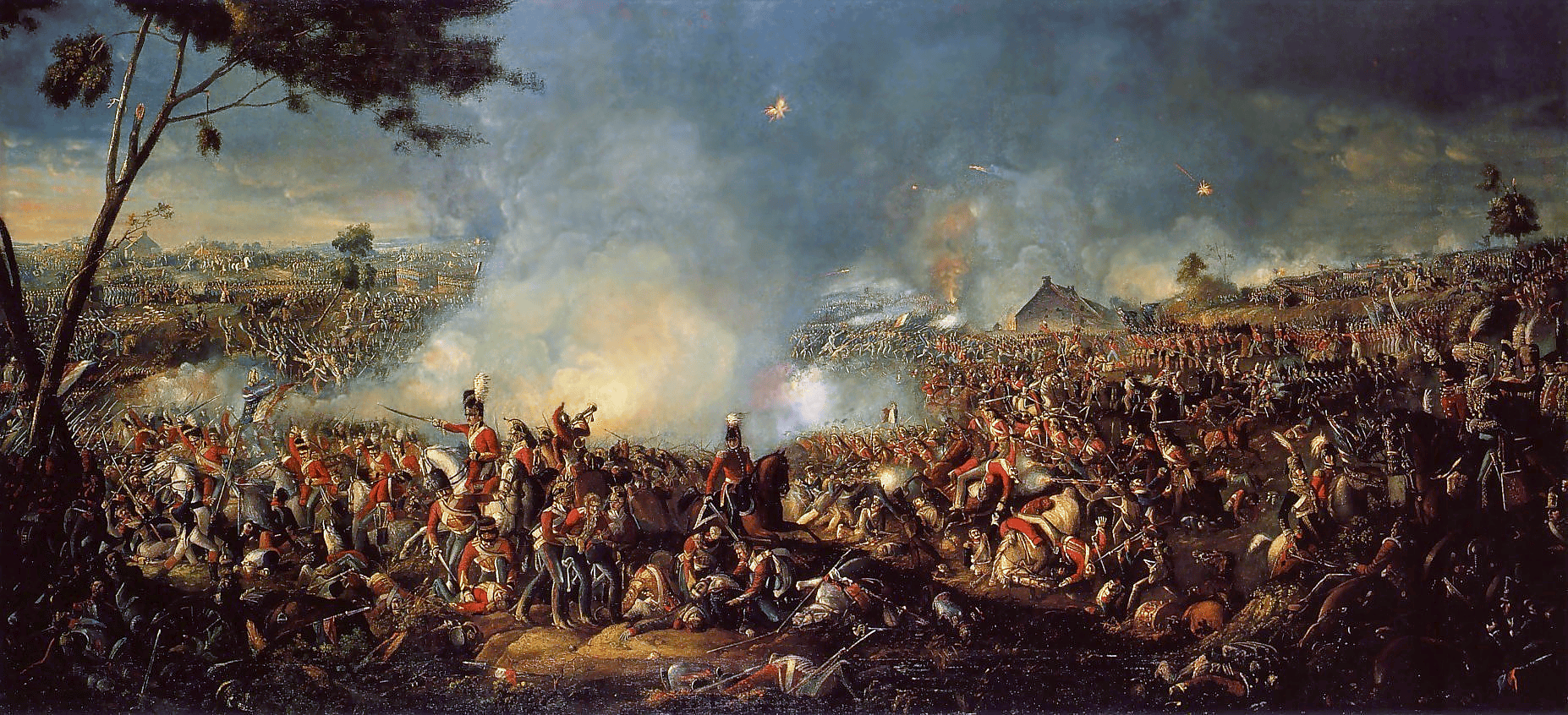
The first wave was about 5,000 men — cuirassiers in steel breastplates, lancers, mounted carabiniers — pouring up the slope into the mouth of Wellington’s center. Wellington’s infantry had already drilled the answer. As the horsemen crested the ridge, the British, Hanoverian, King’s German Legion, and Brunswick battalions formed into squares — hollow four-rank formations of around 500 men each, bayonets bristling outward on every side. A square that holds its discipline cannot be broken by cavalry alone. The horses will not impale themselves on the bayonet hedge, and the riders on top cannot reach into the formation with sabers or lances. The result is a stand-off in which the cavalry mills around outside, makes themselves targets for the muskets inside, and accomplishes nothing.
Ney charged the squares again. Then again. Then again. Over the next two hours he sent in wave after wave of cavalry — eventually committing close to 9,000 horsemen — against roughly twenty British and Allied squares spread across the ridge. Andrew Roberts argues bluntly in Napoleon: A Life that Ney had lost his head. David Chandler’s Campaigns of Napoleon makes the technical point that Ney was attempting with one arm what only the combined-arms attack of infantry, cavalry, and artillery together could ever have achieved. Cavalry against formed infantry, with no support, is a tactical mistake every marshal had been taught to avoid. Every marshal in the French army knew this. Ney knew it.
So why did he do it?
The conventional explanation is that Ney panicked, or that he was seized by the kind of berserk personal courage he had shown his whole career. I think the more interesting reading is political. Ney was the marshal who, four months earlier, had personally promised Louis XVIII to bring Napoleon back in an iron cage — and who had defected the moment he met him. If Napoleon lost this battle, Ney would not just lose his position. He would be executed for treason as soon as the Bourbons returned. Ney was not fighting like a man weighing tactical odds. He was fighting like a man who knew that anything less than total victory ended in a noose. (And he was right. He was shot for treason in December 1815.)
While the cavalry charges burned themselves out against the squares, the real crisis of the battle was unfolding 200 yards south, at the walled farmhouse of La Haye Sainte.
Major George Baring of the King’s German Legion had held the farm since dawn with about 400 riflemen. He had sent message after message back to British headquarters asking for resupply of rifle ammunition. He received none — the supply train carried musket cartridges, which fit the standard British “Brown Bess” musket but not the Baker rifle his men carried. Baring’s account, written in the 1830s, is matter-of-fact about it: by mid-afternoon his men were down to their last rounds.
Around 6:00 p.m. — some sources say 6:30 — La Haye Sainte fell. French infantry climbed onto the roof of the barn, broke in through the courtyard, and Baring’s surviving riflemen, perhaps 40 men out of his original 400, fought their way out at bayonet point and escaped back toward the British line.
This was the moment Wellington nearly lost the battle.
With La Haye Sainte in French hands, the center of his line was now within close musket range of a fortified French firebase. French sharpshooters and horse artillery moved up to within 300 yards of the British center and began firing point-blank into the squares. The 27th Inniskillings, an Irish regiment forming a square just behind the Brussels road, took 463 casualties out of 740 men — dying standing in formation, unable to move without breaking the square that was keeping the cavalry off them. Wellington, by every account, knew his line was now hanging on by the minute. The famous quote attributed to him — “Night or the Prussians must come” — is at least the sense of what he said, even if the exact wording is debated.
The Prussians were now coming, hard. Bülow’s IV Corps had reached the village of Plancenoit on the French right flank around 4:30 p.m. and was already drawing French reserves out of the main fight. Two more Prussian corps were on the road. Napoleon had to make a choice.
By 7:00 p.m., the battle had been going for seven and a half hours. Wellington’s line was bent badly. La Haye Sainte was gone. The British heavy cavalry was already spent. And Napoleon was preparing the last reserve he had — the Imperial Guard.
The Imperial Guard attack and the collapse
By 7:00 p.m., Napoleon had run out of options.
His cavalry was wrecked. d’Erlon’s I Corps was rebuilt but battered. Reille’s II Corps was still being chewed up around Hougoumont. On his right flank, the Prussians had taken the village of Plancenoit, lost it to a counter-attack by the Young Guard, and were grinding their way back into it for a second time with two fresh corps. The eastern half of the French army was now committed to a battle it had not expected to fight, against an enemy that was growing in strength by the hour. Napoleon had one reserve left — the Imperial Guard — and he committed it.
This is the part of the battle the legend has gotten most wrong, and it’s worth getting right.
Popular accounts almost always say “the Old Guard attacked at Waterloo.” The Old Guard — the legendary veterans, the grognards, the men who had fought at Austerlitz and Borodino and a dozen other battles — were on the field. But the attack that went up the slope around 7:30 p.m. was led by the Middle Guard, five battalions of perhaps 3,500 men, with two battalions of the Old Guard following in support. The distinction matters because the Middle Guard, while elite, were not the mythological unbreakable veterans of the Austerlitz era. They were a slightly less terrifying version of the same idea. Andrew Roberts is careful about this in Napoleon: A Life, and so were the French officers who survived the battle. The myth simplified it later.
The Guard advanced in five battalion-sized squares up the slope toward Wellington’s center-right, slightly west of where d’Erlon had attacked four hours earlier. They came under heavy artillery fire and kept moving. They reached the top of the ridge. And then the trick that Wellington had been using all day — the reverse slope — was about to be used on the Guard.
Hidden in the wheat just behind the crest were the British Foot Guards under Major General Peregrine Maitland, lying down in two ranks. As the leading French battalion crested the ridge, Wellington reportedly gave the order Maitland would make famous (or, more accurately, that British memoir writers would make famous on Maitland’s behalf): “Up, Guards, and at them!” The British Guards rose from the wheat and fired a volley at close range — somewhere between 30 and 50 yards — into the front of the Middle Guard column. The French front rank went down. The British Guards stepped forward and fired again. Then again.
The Middle Guard wavered. A second French battalion came up alongside, was hit by another volley delivered by the 52nd Light Infantry under Sir John Colborne firing into their flank, and started to fall back. And then a cry went up along the French line that no French soldier had ever heard before in a battle of the Empire.
La Garde recule.
The Guard is retreating.
The Imperial Guard, in the imagination of every line soldier in the Armée du Nord, was the unit that did not break. They had been Napoleon’s instrument of decision in twenty campaigns. They were the reserve you held back until the moment of victory and then released to finish a beaten enemy. To see them coming back down the slope — bloodied, disordered, retreating — was, for the French soldiers watching, the visible signal that the battle was over. Within minutes the cry along the French line changed from La Garde recule to Sauve qui peut — every man for himself.
Wellington, who had spent eight hours mostly on the defensive, saw what was happening and made the only offensive decision he had to make all day. He raised his hat above his head — by all accounts the agreed signal — and ordered a general advance. The entire British and Allied line, which had been bent and bleeding all afternoon, came down off the ridge.
Not all of the Guard ran.
Two battalions of the Old Guard, who had not been part of the main attack, formed squares and tried to cover the retreat. They were surrounded, cut up, and ordered to surrender. The British general Hew Halkett rode forward and offered terms. The reply from General Pierre Cambronne is the most famous quote of the battle, and there are two versions. The romantic version, polished by 19th-century French journalism, is “La Garde meurt, elle ne se rend pas” — the Guard dies, it does not surrender. The version Cambronne supposedly actually said, much shorter and considerably less suitable for monuments, is “Merde.” Many modern historians lean toward the second, including Roberts. Cambronne himself spent the rest of his life denying he had said the heroic version.
Napoleon, watching from the ridge near La Belle Alliance, briefly tried to die. He attempted to ride into a square of the Old Guard to share its fate, and was physically pulled away by his aides and pushed onto the road back toward Charleroi. His carriage, with his hat and personal papers inside, would be captured by Prussian cavalry that night. He never commanded an army again.
By 9:00 p.m., it was over. The Prussian IV and II Corps had broken through the French right at Plancenoit, while Zieten’s I Corps was rolling up the French left further north. Wellington’s army was pushing down off the ridge. The Armée du Nord, the army Napoleon had built in three months for the Hundred Days gamble, ceased to exist as an organized force in a matter of about ninety minutes.
Wellington and Blücher met near the inn at La Belle Alliance, in the dark, surrounded by burning farms and dying men and the wreckage of two armies. Both were too exhausted to speak much. Blücher, in the only piece of French he could remember, said “Mein lieber Kamerad — quelle affaire.” My dear comrade — what a business.
It is the most exact thing anyone said about Waterloo, in any language, on the day it happened.
Aftermath — the pursuit, the casualties, the end of Napoleon
The fighting at Waterloo stopped around 9:00 p.m. The dying did not.
Wellington’s army was too exhausted to pursue. The British and Allied infantry had been standing in or near formation for ten hours under artillery fire, cavalry charges, and close infantry attack; many regiments had taken 30 to 50 percent casualties and could not have advanced another mile if ordered to. Wellington made the decision, by all accounts a grim one, to halt at the battlefield. The pursuit fell to Blücher and his Prussians, who took it up with a savagery the campaign had not yet seen.
This is a part of the Waterloo story that the British and French accounts have tended to soften, and that the Prussian sources are blunt about. August von Gneisenau — Blücher’s chief of staff, the man who had given the war-saving order to retreat north toward Wavre two days earlier — led the pursuit personally. He had served in the disastrous 1806 campaign that broke Prussia as a state for the better part of a decade. He had spent nine years waiting to return the favor.
Peter Hofschröer’s 1815: The Waterloo Campaign is unsparing on this point: the Prussian pursuit through the night of June 18–19 was not the polite professional pursuit of European warfare. It was payback, conducted by torchlight, against an enemy whose officers were given no quarter and whose stragglers were killed rather than captured.
The Prussian cavalry caught Napoleon’s carriage near Genappe and ransacked it. Inside were Napoleon’s hat, his diamond-mounted sword, his personal correspondence, and a chamber pot. The Emperor himself had abandoned the carriage minutes earlier and continued on horseback. He reached Charleroi by dawn on the 19th and Paris by the morning of June 21.
The casualty figures from the day itself are staggering for a battle fought on a frontage of two and a half miles. The standard figures, drawn from Chandler and Roberts and broadly agreed by modern scholarship, are roughly:
- French: 25,000 killed or wounded, 7,000–8,000 captured, plus another 15,000 who deserted in the days that followed. The Armée du Nord effectively ceased to exist.
- Anglo-Allied (Wellington’s army): about 17,000 killed, wounded, or missing.
- Prussian (Plancenoit and pursuit): about 7,000 killed or wounded.
Roughly 50,000 men were killed, wounded, or missing on a piece of ground you can walk across in under an hour. Witnesses who returned to the field on June 19 — including the surgeon Charles Bell, who came over from Brussels to operate on the wounded — described the dead lying in heaps three and four bodies deep along the Brussels road and around the strongpoints. The French officer corps lost a generation in a day.
Wellington’s own staff had been almost annihilated around him: his military secretary Lord FitzRoy Somerset lost his right arm; his cavalry commander Lord Uxbridge lost his right leg (and made the famous remark, “By God, sir, I’ve lost my leg,” to which Wellington reportedly replied, “By God, sir, so you have”); General Sir Thomas Picton was dead; Sir William De Lancey, acting as Wellington’s quartermaster-general, was mortally wounded by a ricochet round shot and died nine days later.
Wellington’s letter to Lady Frances Webster on June 19, written from his headquarters at Waterloo while his army was still counting its dead, contains the most famous sentence he ever wrote outside of an official dispatch: “Believe me, nothing except a battle lost can be half so melancholy as a battle won.” He had won every major battle he had ever fought and Waterloo was the only one that ever made him write something like that.
Napoleon’s collapse was political as well as military. He arrived in Paris on the morning of June 21 and was immediately pressured by the Chamber of Representatives to abdicate. He did so on June 22 — his second abdication in fourteen months. He briefly hoped to escape to the United States, but the Royal Navy had blockaded every French Atlantic port. On July 15, at Rochefort, he surrendered to Captain Frederick Maitland of HMS Bellerophon — and the coincidence of the surname, given that another Maitland’s Foot Guards had broken his Imperial Guard four weeks earlier, is the kind of coincidence history occasionally serves up.
The British government decided that no European prison was far enough away. On October 17, 1815, Napoleon arrived at Saint Helena, a volcanic rock in the South Atlantic 5,000 miles from Europe, where he would live for five and a half years under British guard. He died there on May 5, 1821, almost certainly of stomach cancer, at the age of 51. He was the most powerful man in Europe for ten years and a prisoner on a rock for almost six.
The fates of the marshals who fought the campaign tell their own short story. Grouchy, who had spent June 18 chasing a Prussian army that was no longer where he thought it was, retreated his 33,000 men back into France in good order — and was blamed by Napoleon and by French historians for the rest of the century for losing the battle.
Ney, whose cavalry charges and political desperation had defined the afternoon, was tried for treason in November 1815 and shot in the Luxembourg Gardens on December 7. Cambronne, who said either the heroic thing or the obscene one, was tried, acquitted, and lived in retirement until 1842. Soult, who had warned Napoleon over breakfast not to underestimate Wellington, served under three subsequent French regimes and lived until 1851 — long enough to read the first French translations of Wellington’s dispatches and presumably to feel quietly vindicated.
There is one more thing worth saying before we close. The conventional reading of Waterloo is the Wellington quote — “the nearest run thing you ever saw in your life.” It’s a great line, and on the battlefield itself it was true. But the more honest reading, looking at the structural conditions of the Hundred Days, is that Napoleon could have won at Waterloo and still lost the war within four months. The Russians and Austrians, with about 400,000 men between them, were already crossing the Rhine in late June. The Seventh Coalition was committed to deposing him regardless of what happened in Belgium. Waterloo decided the date and the manner of the Empire’s fall. It did not, by itself, decide that it would fall. I’ve broken this argument out more fully in why Napoleon lost at Waterloo.
That distinction is what the next section is about.
Battle of Waterloo legacy: why it still matters
The most striking thing about what followed Waterloo is what did not happen.
For ninety-nine years — from June 1815 to August 1914 — Europe avoided a general war of the kind that had ravaged it for the previous three centuries: a continent-spanning multilateral catastrophe involving all the great powers at once. There were colonial wars, civil wars, regional wars, and limited continental fights — the Crimean War, the Austro-Prussian War, the Franco-Prussian War — but no general conflagration of the 1792-to-1815 type. Historians call this the Hundred Years’ Peace or the Concert of Europe, and it is one of the most unusual sustained periods of stability in European history. It is also, almost certainly, a direct consequence of the diplomatic and military order that the defeat of Napoleon made possible.
That order was hammered out at the Congress of Vienna, which had been meeting since September 1814 and which resumed its work after Napoleon’s second abdication. The settlement Vienna produced — a balance of power maintained by a Concert of Europe, conservative monarchies restored from Madrid to Saint Petersburg, the principle that no single state should be allowed to dominate the continent — would shape European politics for the next century. Adam Zamoyski’s Rites of Peace is the standard modern English-language treatment of the Congress, and it makes the point that almost every feature of nineteenth-century European diplomacy traces back to decisions taken in Vienna in 1814 and 1815. Waterloo did not write that settlement. But Waterloo guaranteed it would hold.
For Britain, Waterloo was the start of a century.
The Royal Navy had already won the maritime war at Trafalgar in 1805. Waterloo gave Britain the corresponding land victory, and with it the political weight to shape the post-Napoleonic order largely on British terms. The British Empire entered a period of expansion that would dominate the rest of the nineteenth century and the first half of the twentieth; the pound sterling became the world’s reserve currency; English became the language of global trade. None of that was inevitable in 1814. Most of it was already plausible by 1820. Waterloo is one of the hinges on which that century turned.
For France, Waterloo was the end of revolutionary ambition. The country that had produced the Estates-General, the Terror, the Directory, the Consulate, and the Empire — five regimes in twenty-five years, each trying to remake Europe in its image — was finally exhausted. France would have another revolution in 1830, another in 1848, another Empire under Napoleon’s nephew Louis-Napoleon (which would collapse at Sedan in 1870), and finally a Third Republic. But it would never again be the destabilizing continental power it had been from 1792 to 1815. The Hundred Days were France’s last attempt to dominate Europe through its army. The attempt failed, and the country knew it had failed.
For Prussia, the consequences were quieter but in the long run more important. Prussia had been the smallest of the major coalition powers at the start of the wars. Waterloo confirmed its arrival as a first-rank European military state and gave it the Rhineland territories — coal, iron, and the future industrial heart of Germany — at the Vienna settlement. The Prussian general staff system, developed during the Napoleonic Wars and refined afterward, would in 1866 defeat Austria and in 1870 destroy the France of Napoleon III, unifying Germany in the process.
The seeds of 1870 and arguably of 1914 were planted in the Vienna settlement that Waterloo made possible. This is the part of the Waterloo story that the British and French popular accounts almost never tell. It is the part the German histories take most seriously.
The cultural shadow of the battle has lasted as long as the political one.
“Waterloo” entered English as a permanent metaphor for total defeat — “to meet one’s Waterloo” — and that metaphor has had a remarkable shelf life. ABBA used it in 1974 to win the Eurovision Song Contest. Politicians and sports columnists have been using it since the 1820s.
The Lion’s Mound, the artificial 140-foot hill of earth built on the battlefield between 1820 and 1826 to commemorate the Prince of Orange’s wound, is still the visual focal point of the site and has been a tourist destination since the year it was finished. The Belgian state has preserved most of the original ground. Hougoumont, the chateau Macdonell closed the gates of, was extensively restored for the bicentenary in 2015 and is open to visitors today. La Haye Sainte and La Belle Alliance still stand. You can walk from one end of Wellington’s line to the other in under an hour, exactly as you could on June 19, 1815.
And then there is the Napoleon problem.
Napoleon should, by any rational measure, have been forgotten within a generation. He lost the war he started. He was exiled twice. He died alone on a rock five thousand miles from anywhere that mattered. Almost every political project he undertook was reversed by 1815. The Bourbons were back on the French throne within months of Waterloo. The Code Napoléon survived him — that is real — but the empire he built did not.
And yet the cult of Napoleon, which began in his lifetime and survived his death, is one of the most extraordinary afterlives in modern history. By the 1840s the French government was negotiating to bring his body back from Saint Helena; the retour des cendres of 1840 was a state event of imperial proportions. By the 1850s his nephew was running France. By the 1900s historians on both sides of the Channel were producing the first scholarly biographies. By the 2020s he was the subject of streaming documentaries, Netflix films, and a vast popular literature in English, French, and Russian. Andrew Roberts cites the often-repeated claim that more books have been written about Napoleon than about any other human being except Jesus Christ and possibly Shakespeare. Whether or not the count is exact, the fact that anyone bothers to make the comparison is the point.
Waterloo is where that story ends, and also where it begins. The Empire died on the ridge at Mont-Saint-Jean. The legend started the morning after.
If you want to understand why people still write about Napoleon more than two centuries later, the place to begin is the cold farmhouse breakfast where he laughed at Marshal Soult and told him Wellington was a bad general — and the gray evening, ten hours of fighting later, when he tried to ride into a square of his Old Guard to die with them, and was pulled away to live, and to lose, and to become the only kind of immortal a man like him could ever have become.
That is the complete story of the Battle of Waterloo.